How these tours are made
The Impressionism tour at the National Gallery of Art took eleven builds between October 26 and November 6, 2026. I made it with Claude, an AI assistant. This page says what each of us did, stage by stage, with the numbers from the record.
| I do | Claude does |
|---|---|
| Walk the galleries and photograph every work and its label. | Pair each label with its work and transcribe every card word for word. |
| Open the sources a website will not show a machine. | Research each work and verify every claim and quote at its source. |
| Pick the detours from a ranked list. | Write every stop to the same parts, and the detours and gallery talks. |
| Choose every voice by ear. | Crop the photos, cast the candidate voices, and record the tour. |
| Approve each version and say what is wrong on a listen. | Build the page, test it at phone size, and publish the fix. |
Stage 1The visit
On October 26, 2026, I walked the ten Impressionism galleries on the main floor of the West Building, M80 to M89, and photographed every painting and the wall label beside it, in walking order. That took 36 minutes, 12:38 to 1:14 pm, and 274 photos: 128 works, their labels, the room panels, and the doorway signs that mark where one gallery ends and the next begins.
The photos went from my phone to a shared folder. Claude took them from there at 1:43 pm, and the first playable version, without research, was on my phone at 2:43.
Stage 2Pairing and transcribing
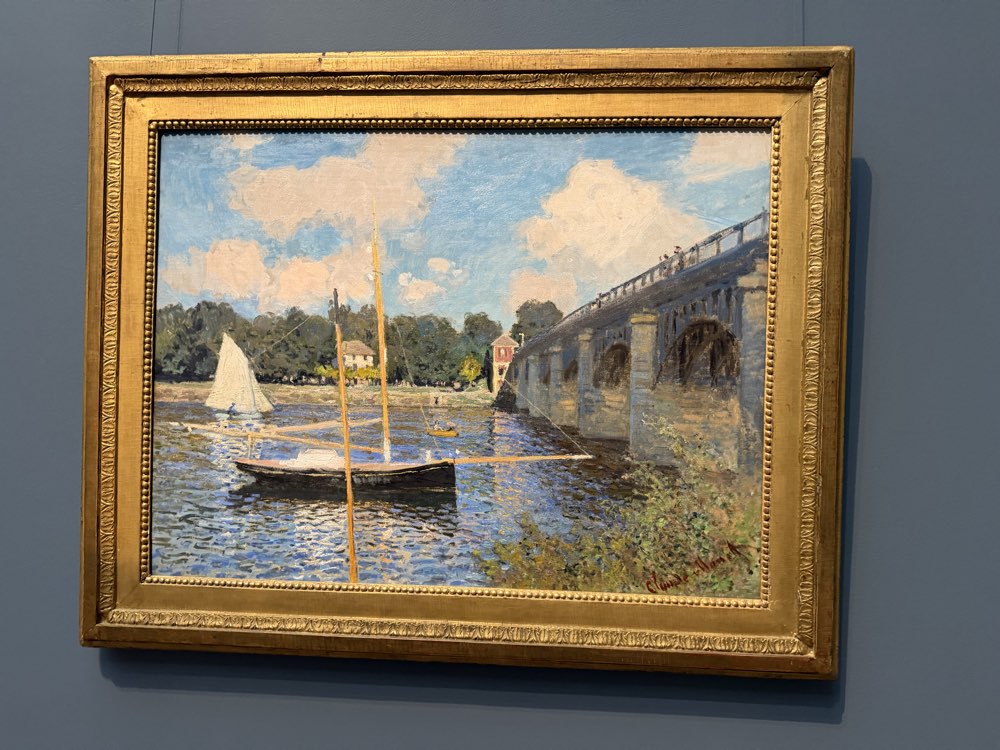
Claude reads every photo and sorts them: works, labels, room panels, doorway signs, duplicates. Each label is matched to its work by the order the photos were taken and by what the card says. When the match is inferred rather than certain, that is written down, and the stop carries a small "Label match" line that says so. On this tour the note was needed where two cards shared one photo, where a label was shot before its painting instead of after, and where three Monet canvases of Waterloo Bridge hung in a row.
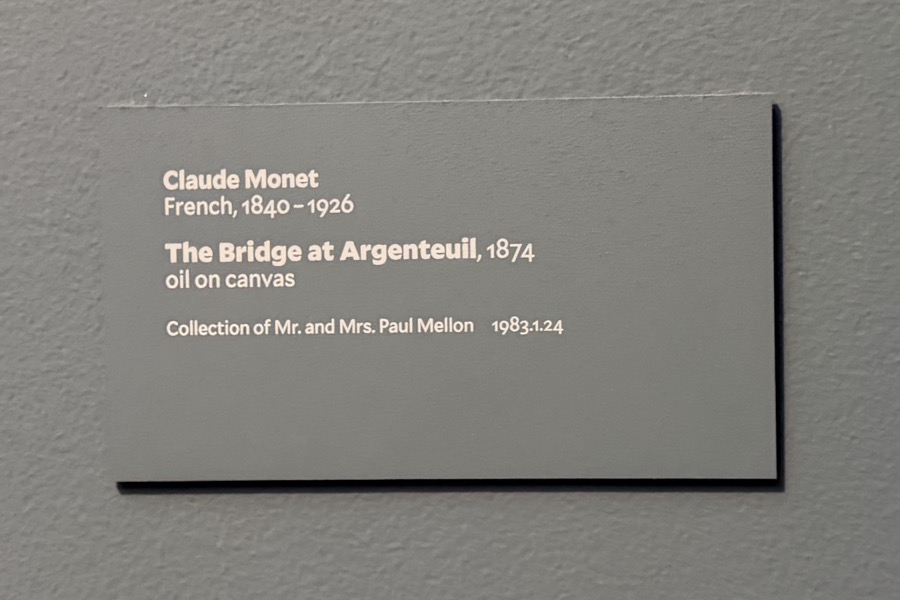
Then Claude types out every card, word for word, from the photo. Names, dates, numbers, and credit lines are checked one by one against the picture. No machine transcription is used, because on an earlier tour an automatic reading of one room panel got five names wrong. The transcribed card is the floor of every stop: a check refuses to build a stop that is missing a line of its card.
Claude Monet
French, 1840 – 1926

The Bridge at Argenteuil, 1874
oil on canvas

Collection of Mr. and Mrs. Paul Mellon    1983.1.24
Stage 3Research
Research runs in two passes. The first is an outside deep-research pass: Claude writes a long brief from the transcribed labels and sends it to a research service that comes back with background, sources, and candidate quotes. For these galleries that delivery covered 181 works and 56 artists. It is marked not vetted and stays that way until each claim is opened at its source.
The second pass is Claude's own. For every stop it opens the sources behind the claims the stop will rely on, reads the museum's own text for the work, and fills the gaps. Each stop's background cites the sources it was written from; the index for this tour holds 441 of them. When a website refuses an automated reader, as the National Gallery's did, Claude reads the page through a browser or an archived copy, and when a site puts up a bot check, I clear it or download the page myself and hand it over.
Quotes are kept only when Claude has seen them on the page the citation names. For the first researched version, 62 quotes were found and 49 verified; the 13 that could not be verified stayed off the page. After the detours were added, the count was 119 found and 108 verified, with 11 kept off. A quote is never paraphrased, and a stop with no verified quote says so.
Stage 4Writing each stop
Every stop has the same parts, in the same order: the label block, the card word for word, a description of the picture itself, "Beyond the label" with its sources, the artist's own words, and "Look for," a note on technique written for someone who makes things. A stop may add a reading, and when it does the text says "a reading, not the museum's." The description is written with the cropped photo open, not from anyone else's account of the painting; an outside description once nearly put an error into a stop.
Each stop also opens with one sentence that says what the picture shows, so the detailed description can be skipped on the page. Thirty terms, from impasto to scumbling, are defined in a glossary and tap to open. Nine stops make a twenty-minute route for a short visit.
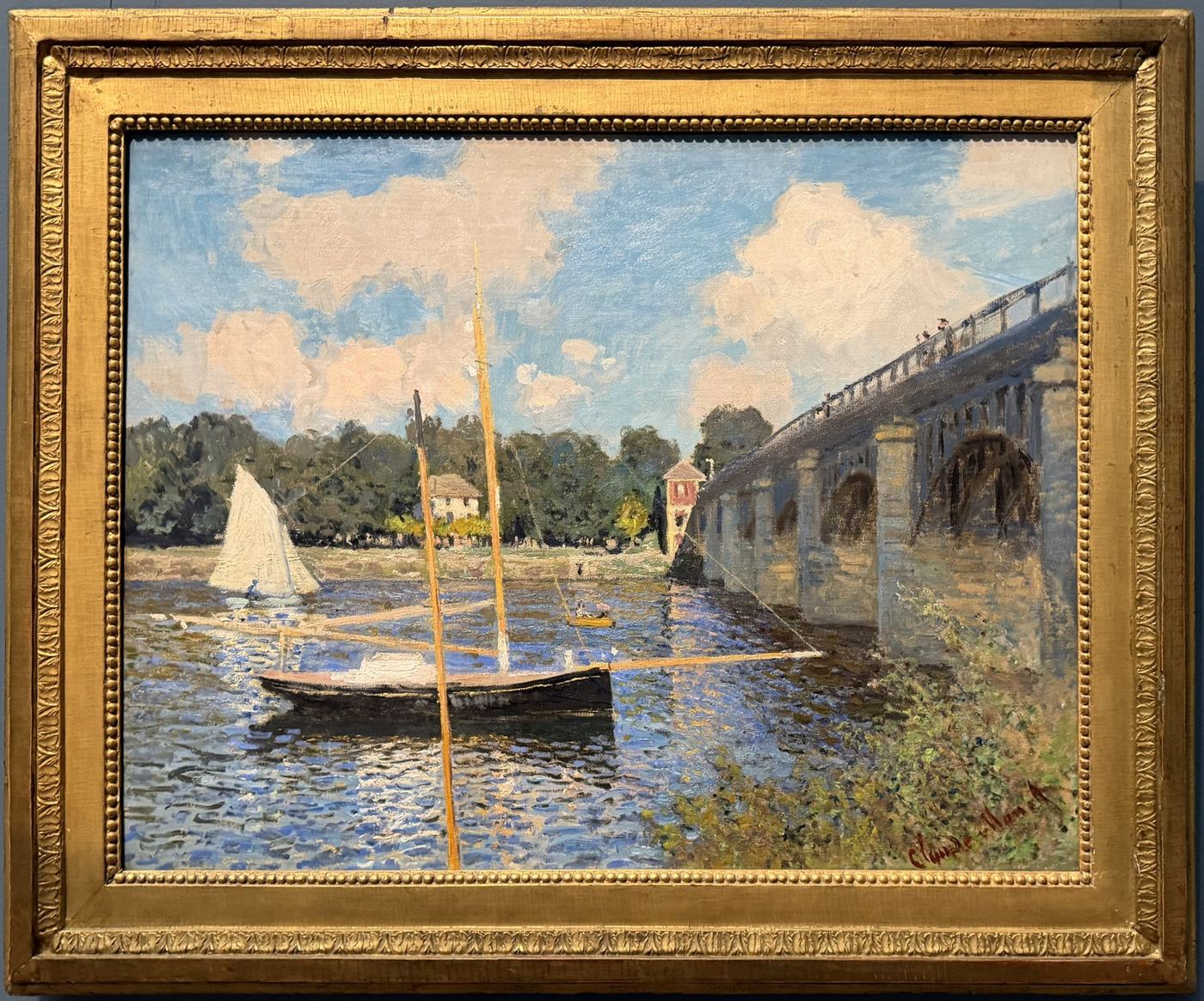
Look at the water against the poles. The river is broken color: short horizontal dashes of blue, white, violet, and ochre set side by side and barely blended, so the surface reads as scattered light, not modeled form. The yellow poles are single long strokes laid over that field, with the water strokes visibly running underneath. The clouds are the thickest paint here, creamy impasto that stands up off the thinner blue around it.
Monet gave this advice to the American painter Lilla Cabot Perry, as she remembered it: "When you go out to paint, try to forget what objects you have before you, a tree, a house, a field or whatever. Merely think here is a little square of blue, here an oblong of pink, here a streak of yellow, and paint it just as it looks to you, the exact color and shape, until it gives your own naïve impression of the scene before you."
The narration is built from the page text with a few rules of its own. A section heading like "Beyond the label" is not read aloud; the audio pauses for 1.6 seconds instead. "Look for" opens with a short lead-in that changes from stop to stop. Each sentence has to carry a fact: no teaser lines, no scene-setting, no superlatives.
Stage 5Cropping and straightening the photos
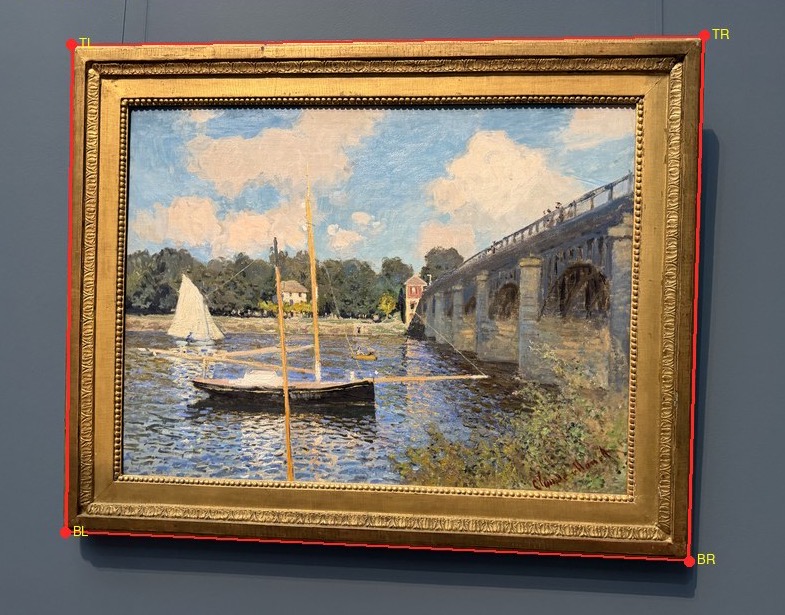
A gallery photo is taken from where the floor allows, so the frame is a trapezoid and the colors carry the room's light. Claude marks the four corners of the frame on a gridded contact sheet, by eye; an optional step then nudges each corner to the nearest real edge. The marked corners are used to warp the full-resolution original, 5,712 pixels wide, into a straight rectangle. Each result goes on a review sheet, the marked photo beside the crop, and Claude reviews the sheets before the page is built. The page gets a 1,400-pixel copy of each crop.
Stage 6Detours and gallery talks
A detour steps away from one work into a wider story: a war, a trial, a collector, a Washington connection. Claude ranks the candidates from the research into a list with a pitch, a type, and sources for each, and I pick. On this tour the list had twenty. I kept two for the first researched version, the slum clearance behind Manet's Old Musician and the trial of the critic who owned Seurat's seascape, and later that day asked for the rest. Each of the other eighteen was researched and source-checked again before it went in the next day. Twenty detours are on the tour, each with a slideshow; the slideshows hold 149 pictures, and Claude checked every one against its caption and the narration before it was kept.
Twelve gallery talks sit between the stops: one for each of the ten rooms, one on paint in a tube and the synthetic pigments the painters bought in it, and a closing talk on what the critics said and where history reversed them. The first talk opens with a point the docent on my visit, Mary O'Neil, made: the avant-garde is painters adapting to the present environment.
Stage 7Casting the voices
The tour has two narrators and a cast. One voice reads the stops; another reads the detours and the talks, so the change of register is audible. Eighteen of the quoted artists speak in voices of their own, kept in a shared registry so Monet sounds the same on the next tour; the narrator reads the rest, and the letters and documents. The voices are from ElevenLabs.
I choose every voice by ear. For the stop narrator Claude recorded seven voices reading stop 1; for the detour narrator, eight voices reading one detour paragraph. For the quotes Claude built a casting sheet of 46 candidate voices for 18 artists, each reading that artist's own lines, and I listened and picked. A voice has to match the speaker's ethnicity and region; a voice that erases who someone was is not offered.
Two choices came from listening to samples. A sound effect was tried at the break before the background and did not land, so the audio pauses instead. Quotes play with the original French under the English, as sound design: the English carries the words. Where the French original was already verified it is used, 27 quotes here; 22 play over a French rendering of the English, read for sound and never shown on the page; 3 play in English only. Foreign names and passages, 258 words and 17 passages on this tour, go on a pronunciation list and are read by native voices.
Stage 8Recording
Claude records the tour from the page text. This tour is 160 tracks, 128 stops and 32 segments, about 353,000 characters of narration, recorded two tracks at a time in about 70 minutes. Each quote is recorded in its speaker's voice with the French bed under it, each track is levelled to a common loudness, and the recorded text of each track is fingerprinted. If a stop's text changes after it was recorded, the fingerprints no longer match, the track is marked not ready, and the tour will not publish until that stop is recorded again. Fixing one stop means recording that stop, not the tour.
The first versions were recorded on free voices, and I found the detour voice robotic on a listen. The whole tour was recorded again on ElevenLabs on November 6, and that is the audio on the tour now.
Stage 9Building the page
The tour is one page. Tap a painting in the grid to hear its stop; the grid sorts by walking order, by gallery, or by artist, and the detours sit in it as tiles at their place in the walk. Every work with a date is on an artist timeline, 145 of them here, with context rows for Haussmann's rebuilding of Paris, the Franco-Prussian War and the Commune, the eight Impressionist exhibitions, and five more. What the page offers, each remembered on your phone:
- Descriptions on or off: the detailed description of each picture can be skipped, leaving the one-sentence scene line.
- Bell: after a track ends, a chime every 30, 60, or 90 seconds while you keep looking, or off.
- Play through: each stop runs into the next to the end of the tour, with no bell between.
- Mark seen: a mark on each stop you have heard, and a two-tap reset.
- Glossary words that open a definition when tapped, and slideshows on the detours that change picture when the audio reaches it.
Each build is a separate dated file. A build fails if any label date cannot be read for the timeline or a glossary term has no entry, and it names the stop.
Stage 10Testing
Before any version goes up, Claude runs the page in a headless browser at phone size, 390 by 844, through 18 checks: tap plays and scrolls to the stop, the bell loads when a track ends, marks survive a reload, the two-tap reset, the glossary pop-up, the Stop button, the timeline, the grid sorting and the detour tiles, the dark color scheme, the Descriptions switch, the slideshows, the Bell setting, and Play through. A page whose text changed after recording fails the fingerprint check and is not published. Then I listen. The first version read every accession number aloud, which I found on the first listen; the fix went into the next version.
Stage 11Publishing, versions, and fixes
The tour is served from this site. The audio is sent in byte ranges, because an iPhone will not play or seek a track otherwise. A fix is a new numbered build, tested the same way, that replaces the page at the same address; every earlier build is kept as its own file.
- October 26
- First version, an hour after the upload: cards, pictures, and "Look for," voiced, no research. The same evening: background on every stop, 49 verified quotes, ten gallery talks, the critics, and the two detours I picked.
- October 27
- All twenty detours.
- November 5
- The scene line on every stop and the Descriptions switch, the pronunciation list, quoted speakers in their own language with an English voice over, and slideshows on all twenty detours. Recorded once, in one pass, after I had finished making changes.
- November 6
- Recorded again on ElevenLabs with the voices I chose: a pause where the headings were, spoken attributions on every quote, the French bed, the Bell setting, the talk on paint in a tube, and a passage on the Salon des Refusés at Manet's Railway. Later the same day, Play through.
The standing choices from this build, the voices, the Descriptions switch, the Bell, the pause, the anatomy of a stop, carry to the next tour without being decided again.